.jpeg)
Losing most or all of your teeth affects more than your appearance. Eating becomes more difficult. Speaking can feel different. And if you're wearing dentures that slip, cause soreness, or feel unreliable, it's worth knowing what the alternatives look like.
Full mouth dental implants offer a longer-lasting, fixed solution for people who have lost all or most of their teeth. This post explains exactly what they are, how the process works, and how to know if you're a suitable candidate. Whether you're in Myrtleford or across Victoria’s High Country, this guide is for you.
Full mouth dental implants replace all missing teeth in the upper jaw, the lower jaw, or both – using a fixed prosthetic (a bridge or denture) that is anchored to multiple implants placed in the jawbone.

Instead of replacing each tooth one by one, a full arch of teeth is supported by just four to six titanium implants. This approach is commonly known as All-on-4 or All-on-6, depending on how many implants are used.
The implants are made from medical-grade titanium. Once placed in the jawbone, they fuse with the bone over time through a natural process called osseointegration. This creates a firm, stable base for the replacement teeth above.
The result is a fixed set of teeth – not a removable denture – anchored firmly in place and designed to support everyday activities like eating, speaking, and smiling
Your journey starts with a thorough dental examination. This includes:
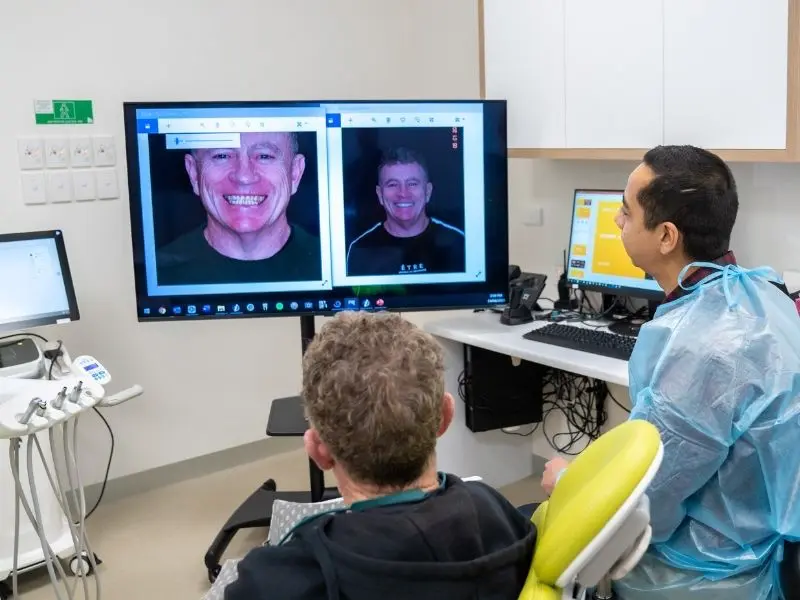
This step determines whether you are a suitable candidate and what your personalised treatment plan looks like. At Great Alpine Dental, Dr. Amit uses advanced imaging technology to plan your treatment with precision before any procedure takes place.
Once your assessment is complete, a personalised plan is created. This includes:
On the day of dental implant surgery, the titanium implants are placed into the jawbone under local anaesthesia or sedation. Many patients report that the procedure is more comfortable than they expected.
A temporary set of teeth is fitted within a few days, so you are not without teeth during the healing period.
Over the next four to six months, the implants fuse with the jawbone. During this time, you will need to:
Once your implants have fully integrated, your permanent prosthetic teeth are attached. These are custom-made to fit your jaw and match the appearance of natural teeth. After this step, normal eating and speaking can resume.

Full mouth dental implants, also referred to as entire mouth dental implants or whole mouth dental implants, are considered for people who:
This treatment is also commonly explored by older adults. Dental implants for seniors and elderly patients are increasingly common, as many people in their 50s, 60s, and beyond experience tooth loss from decay, gum disease, or injury.
Not everyone is a suitable candidate right away. Factors such as jaw bone density, overall health, and smoking history can affect outcomes and will be thoroughly assessed before any treatment begins. A consultation is the only way to know for certain.
For many patients, the stability and comfort of implants make them a preferred option over traditional dentures. That said, every person's situation is different. A thorough clinical assessment will help determine which option is right for you.
You do not need to travel to Melbourne or Sydney to access this level of care.
At Great Alpine Dental on Myrtle Street in Myrtleford, Dr. Amit brings extensive experience in dental implant treatment to the High Country, serving patients from Myrtleford, Wangaratta, Bright, Beechworth, Albury-Wodonga, and beyond.
Using advanced technology, including 3D imaging and CAD/CAM dentistry, the practice delivers precise, personalised implant treatment without the need for a long drive to the city.

Dental implants require consistent daily care to maintain their function and longevity. Here is what good maintenance looks like:
With proper care, dental implants can serve you well for many years. Your dentist will provide specific guidance based on your individual treatment.
{{cta}}
Full mouth dental implants is a general term for replacing all teeth in one or both jaws using implant-supported prosthetics. All-on-4 is a specific technique where four implants support a full arch of replacement teeth. All-on-4 is one of the most common approaches used in full mouth implant treatment, and in many cases, the two terms refer to the same procedure.
The full process typically takes between six months and one year from initial consultation to the fitting of your final prosthetic teeth. This includes time for healing and osseointegration. The timeline varies depending on your individual case, including whether additional procedures such as bone grafting are required.
The surgical placement of implants is carried out under local anaesthesia, and sedation options are available. After surgery, patients commonly experience some swelling and tenderness for a few days. Your dentist will discuss pain management options and what to expect during recovery at your consultation.
Bone loss in the jaw is common among people who have been missing teeth for some time. Depending on the degree of bone loss, you may still be suitable for implant treatment. In some cases, a bone graft procedure may be recommended first to build up the jawbone. Your dentist will assess your bone density using imaging and advise accordingly.
Yes. Alternatives include traditional full dentures, implant-retained dentures (where implants help stabilise a removable denture), and implant-supported bridges. Each option has different costs, maintenance requirements, and functional outcomes. Your dentist can walk you through the options and help you identify what is most appropriate for your situation.
Full mouth dental implants can restore function and comfort for people living with significant tooth loss. The process takes planning and time, but for many patients, it is a worthwhile long-term investment in their oral health.
If you are considering full mouth dental implants in Myrtleford or the surrounding High Country area, the best starting point is a thorough consultation with an experienced practitioner who can assess your individual situation and explain your options clearly.

.webp)
.png)